|
Showing posts with label Rudiments. Show all posts
Showing posts with label Rudiments. Show all posts
Wednesday, January 9, 2013
The Fastest Way To Improve Your Single Stroke Roll
Everyone wants a faster single stroke roll, right? Well, here's an exercise that has really helped me over the years.


Wednesday, February 2, 2011
Is It a 5 Stroke Ruff or a Single Stroke 5?

So when I posted the lesson a few days ago on "5 Stroke Roll Around the Drumkit", there was a bit of confusion on my Facebook page from a question (Go here to check out the original discussion)...but it actually led to a really great discussion, one where I learned a bit of history about the rudiments (rolls in particular) that I didn't already know...and any time I can learn something new, I think it's a cool thing.
Here's the question that sparked the debate:
"Stephen, is that a 5 stroke roll and a 5 stroke ruff you're playing? There is a difference."
From my understanding of the modern 5 stroke ruff, no, it wasn't what I was playing. So after we batted back and forth for a second, some of the peeps that watched the lessons started chiming in...they wanted to know the real answer.
Anytime I'm confronted with something that confuses me, or gives me pause, I go digging for info. The fact is, I rarely care about being right...I just want to understand the topic being discussed...especially in this instance. So I spent an hour or so digging, trying to find out what he was talking about. and here's what I came up with...(part of this was in the original discussion, so it's written in a discussive tone).
"After having time to sit down, dig through my massive amount of percussive literature and dig on reputable sites online, this is what I've discovered. There has long been a discussion among professionals, both in NARD (National Association of Rudimental Drummers) and in PAS (Percussive Arts Society), over correct definitions of rudiments, should there be 26? 40? 120?, what makes something a rudiment, should it be called a ruff or a single stroke roll? (for a great article on this, check out the April 2005 edition of Percussive Notes, which is the journal of PAS)...in other words, we're talking about the same concept here (that being a 5 stroke roll played with singles, or a single stroke 5 versus a 5 strok ruff). The problem comes in the terminology.
Let me explain what I mean...I finished my music degree approximately 5 years ago. The director of Perc. studies was Dr. John Wooton (Click on his name to find out a bit more about him...author of "The Drummers Rudimental Reference Book" and his newest one "Dr. Throwdown's Rudimental Remedies"). I have never heard a single stroke 5 referred to as a 5 stroke ruff, even taking from someone such as Dr. Wooton. Hence me referencing it as a hybrid (part of the earlier conversation I didn't include)...and you're right Matt, it's not a hybrid at all. This DOES NOT mean the 5 stroke ruff does not exist.
Originally the Single Stroke 5 was referred to as a 5 Stroke Ruff. The term "ruff" however, is no longer currently used to denote the single stroke roll, at least not in modern drumming camps. Check out the PAS website, you'll be hard pressed to find anything on there referring to "ruff" as a modern term applied to the single stroke roll. This happens with some words in the drumming community...take the NARD notation of "The Ruff" go here and scroll to #8, which was actually the rudiment I think about when you mention "ruff" (Matt, go here to see what I've seen as a 5 stroke ruff before, only example I could find of it notated how I've seen it)
now go here and scroll to #31. You'll see that what is referred to as "The Ruff" on the NARD site is referred to as a "Drag" on the PAS site. You'll also see that NARD calls one of the rudiments a "Single Drag" and PAS calls it a "Single Drag Tap", the only difference being that one is notated as quarters and the other as eighths, which is insignificant...who's right? THEY BOTH ARE!!! It's essentially the same rudiment. If you looked at a 5 Stroke Ruff and a Single Stroke 5, they will look the same.
Matt is also correct in his reference to Buddy Rich's book "Buddy Rich's Modern Interpretation of Snare Drum Rudiments"--printed in 1942 originally. It in fact DOES show the ruffs separately from the rolls of the same length. However, they are notated the same, accented the same and should sound the same. This might be why most more modern resources don't mention the ruff, or do so passingly. It got to be a very confusing term...and an easy fix was to call a ruff a drag, and to notate "single" within the name of a roll when referring to any denomination of single stroke roll.
So what have we learned here...
-That I need to be frickin' clearer when I post a lesson, lol!
-That Mr. Patella is right...there is a such thing as a 5 stroke ruff and his explanation of that rudiment was correct. That being said, it's the same thing as a Single Stroke 5, just different terminology.
-That this is a hot topic among not just the people on this post, but between the professionals at NARD and PAS. The rudiments are still being debated endlessly.
-That I shouldn't quickly call something a hybrid just b/c I haven't heard of it (although most of the times they are hybrids when I haven't heard of them)
And while we're on the topic of rudiments...
Click here for the PAS 40 Official Rudiments
...and here for 128 Hybrid Rudiments
Sorry, that got long winded...I just wanted everyone to understand what I now understand. Thanks Matt for bringing a bit of history to my awareness and letting me know the original and proper definition of the 5 stroke ruff. I hope this cleared up any confusion.
Please, all of you rudiment buffs weigh in if you'd like...I'm no expert in this area, this is just what I dug up in my research...and I'm very open to being told I'm wrong about things.
Monday, January 24, 2011
The Double Paradiddle Around the Kit
I've had some requests for lessons on incorporating rudiments around the drum kit. Here's one using the double paradiddle...
Saturday, July 10, 2010
Friday, January 29, 2010
Lesson 5: Flam Paradiddle
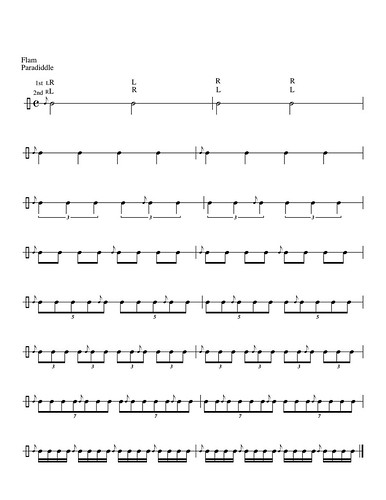
CLICK ON THE EXERCISE TO DOWNLOAD
New rudiment for ya'll to chew on, the almighty Flam Paradiddle. I play this rudiment two ways...
1) With an accent on the flam.
2) Without the accent on the flam.
...again, taking it through the Rhythmic Scale.
I have quite a few of these rudiments written out in this way, so I'll keep posting them for all that are interested. The purpose of running the rudiments in this way is to get you used to thinking in every degree of the scale. We can move on to some deeper stuff a little later, but the foundation has to be there...you have to be comfortable counting the subdivisions before we can work on anything else. Hopefully you're still working on The Blueprint too...alot more exercises to come out of that also, but once again, the groundwork must be laid.
Cheers!
Wednesday, January 27, 2010
Lesson 4: Flam Accents Using the Rhythmic Scale...
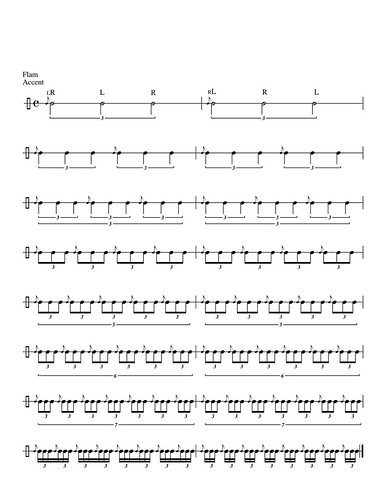
CLICK ON THE EXERCISE TO DOWNLOAD
Ok...last time we started to work through some rudiments, taking them through the Rhythmic Scale, and starting to see what some of the possibilities were. We looked at the flam in the previous lesson...this time we'll look at the Flam Accent. Same general idea, so for the details of how to work through it just refer back to Lesson 3.
Thursday, August 27, 2009
Practicing Rudiments

There's no getting around it...I hate practicing my rudiments. I know, I know, I'm a disgrace to the drumming community. I've just never been real enthused about sitting at a practice pad for hours on end going from slow to fast to slow over, and over, and over, and over...
That's a bad problem to have...the basic rudiments are kinda've like our alphabet. They help with chops, technique, flow, groove, technicality...they were designed as some of the most common stickings that drummers used. We NEED to know them.
I went through a whole semester in college where I focused heavily on my practice pad and working the rudiments...and hated it. It was boring to me. Some love it, I didn't.
So what to do? Well, I turned to the reason I started playing the drums...music...
1) Grab your practice pad and pick out the rudiment you're currently working on or the one that needs the most work.
2) Pick 3-5 of your favorite songs (You'll need to be mindful of the tempos...)
3) Press play on your iPod or cd player or Zune or whatever and go to town. Start by playing the rudiment in 8th notes on the verse. When you get to the chorus, play it in sixteenths, when it goes to the bridge, play it in sextuplets, and so forth. Try playing the verses super soft and the chorus super loud...try a slow crescendo through the bridge from soft to loud...use your imagination!
The end goal is to play the rudiment within the time signature of the song in as many subdivisions and dynamic ranges as possible. Traditionally when you work on your rudiments, you go from slow to fast to slow...doing this allows you to play the rudiment at any speed. It's boring though, and I hate boring practice.
Using actual songs to work the rudiments works on a few different areas: You work the sticking of the rudiment and get it down cold, playing it in the different subdivisions of the beat within the song allows you to work on several speeds as well as train your mind to move seemlessly within the parameters of the tune, playing to music helps your musical senses, and most of all...you never even know you're practicing! We all got into music to play music we love (at least I hope that's why you got into it), so why not find ways to do just that no matter what you're practicing?
After you've got the rudiment down pat and can go in and out of the different subdivisions, take it one step further...sing the song. It doesn't have to be a Grammy winning vocal performance, just work on saying the lyrics in time. Why? Well, I believe in 6 way coordination in drumming...2 hands, 2 feet, your mouth, and your mind (which has to keep constant track of the other 5). Singing allows you to begin to put the rudiment on autopilot so you can focus on the musical issues at hand instead of the technical side of it.
When you've accomplished all of the above on the practice pad, move it all to the kit. Come up with a cool application of the rudiment on the kit and play to the song again, repeating all of the steps above. The possibilities are endless!
Yes, you should still practice rudiments the traditional way...but break out of the status quo way of thinking about your practice and get creative! Creativity never hurt anyone, unless they didn't utilize it...then it can be crippling.
Subscribe to:
Posts (Atom)

